
Thursday, October 30, 2014

Monday, October 20, 2014
Assignment #6
 Dada
is an artistic movement to react about the World War 1. Artists who suffered
from the war or who had been influenced protested and fought for the showing
nonsense of the war by depicting a ridiculous artwork. Artists used common
objects and made it very ridiculously. For example, this picture is “Fountain” by Marcel Duchamp. Unfortunately, the genuine
artwork was lost. He used standard urinal and laid flat on its back rather than
upright in its usual position. The artwork seems very ridiculous and
meaningless. It happened because of harmful consequences of World War 1. The
trend of literature or art was chaotic or unrealistic.
Dada
is an artistic movement to react about the World War 1. Artists who suffered
from the war or who had been influenced protested and fought for the showing
nonsense of the war by depicting a ridiculous artwork. Artists used common
objects and made it very ridiculously. For example, this picture is “Fountain” by Marcel Duchamp. Unfortunately, the genuine
artwork was lost. He used standard urinal and laid flat on its back rather than
upright in its usual position. The artwork seems very ridiculous and
meaningless. It happened because of harmful consequences of World War 1. The
trend of literature or art was chaotic or unrealistic.
Jacob Lawrence is an African-American artist who was born in America.
Mostly, his artwork is about black labors and he was influenced by Goya,
Daumier, Roscoe, Harlem Renaissance, and African-American history. Also, his
art work was influenced by European Modernist Metis. He was good at using
brilliant colors, flat space, and usage of patterns. This picture is “The Shoemaker”
by Jacob Lawrence.
Thursday, October 16, 2014
Assingment #5

Impressionism is about capturing the short moment or glimpse
and paint it very quickly. Also, the impressionist artist valued the light and
the color. People divided impressionism into two part, as the first 20~30 years
of impressionism and after that post-impressionism. At the beginning of the
impressionism, people only cared about the lights, various colors, more
objective paintings and less emotional paintings. They didn’t imply any
meanings or interpretations on their paintings. Just the style was important.
For example, this picture is “Sunrise” by Monet. He depicted the sun through
the mist at Le Havre and he tried to capture the spontaneity of nature. If we
look very close to the painting, then we can see the trace of brushes that Monet
dapped with the brush.
 However, in
post-impressionism, people not only tried same style of others, but they also
implied meanings or imaginations on their paintings. For example, this picture is
“The Yellow Christ” by Gauguin. It depicts some traditional women praying at a
roadside, but it is not a documentary illusion of the scene. It is an attempt
to portray the spiritual vision.
However, in
post-impressionism, people not only tried same style of others, but they also
implied meanings or imaginations on their paintings. For example, this picture is
“The Yellow Christ” by Gauguin. It depicts some traditional women praying at a
roadside, but it is not a documentary illusion of the scene. It is an attempt
to portray the spiritual vision. Thursday, October 9, 2014
assignment #4
The two artworks that I noticed while I was looking around
the Metropolitan Museum were “Madonna and Child Enthroned with Saints” by Raphael,
Raffaello Sanzio, and “Venus and Adonis by” by Peter Paul Rubens. As I looked
into these pictures for a while, I could notice a very distinctive style which
classifies them as a Renaissance and Baroque art.
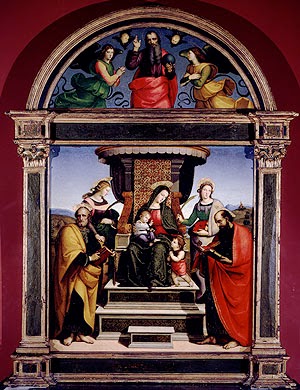 “Madonna
and Child Enthroned with Saints” was painted by Raphael, Italian, approximately
in 1504 or 1505. This painting is an altarpiece which used to be hung on a small
Franciscan convent of Saint Antonio in Perugia. Since this painting was for the
Catholic Church, the theme is related to religion. Hence, in the middle of
painting, Jesus Christ is seating on Virgin’s lap and Young Saint John stands
on base of the throne in which Virgin sat.
Four saints, Peter, Catherine, an unidentified female saint, and Paul
gather around the throne. Above them there is God of father who watches down
the ground or maybe His son holding the earth globe. Next to Him, there are two
angels and infant’s faces. The very distinctive description of this painting
that classifies as a high renaissance artwork is that Raphael used oil painting
and perspective. For oil painting, the colors of gowns are very vivid and
powerful. Before the oil painting was made up people used tempera painting and
with tempera, it was impossible to express light very clearly. Moreover,
perspective was used in painting in renaissance first time. In the background
of the painting, we could see very small tower, which never be able to small.
“Madonna
and Child Enthroned with Saints” was painted by Raphael, Italian, approximately
in 1504 or 1505. This painting is an altarpiece which used to be hung on a small
Franciscan convent of Saint Antonio in Perugia. Since this painting was for the
Catholic Church, the theme is related to religion. Hence, in the middle of
painting, Jesus Christ is seating on Virgin’s lap and Young Saint John stands
on base of the throne in which Virgin sat.
Four saints, Peter, Catherine, an unidentified female saint, and Paul
gather around the throne. Above them there is God of father who watches down
the ground or maybe His son holding the earth globe. Next to Him, there are two
angels and infant’s faces. The very distinctive description of this painting
that classifies as a high renaissance artwork is that Raphael used oil painting
and perspective. For oil painting, the colors of gowns are very vivid and
powerful. Before the oil painting was made up people used tempera painting and
with tempera, it was impossible to express light very clearly. Moreover,
perspective was used in painting in renaissance first time. In the background
of the painting, we could see very small tower, which never be able to small.
“Venus
and Adonis” was painted by Ruben, Belgium, probably mid-1630. This painting is
about Venus who accidently fell in love, because of cupid’s arrow, with the
handsome hunter, Adonis. The very distinctive description that Ruben used is
expression how he painted the human figure or god figure. Body figure and
objects are really exaggerated, overexpressed, and very curved. Moreover, the
word Baroque used to be originated form Portuguese word “barroco”, Spanish “barroco”,
or French “baroque” which mean rough or
imperfect pearl.
Understanding
Baroque and Renaissance artworks aren’t easy. Yet, it is intriguing how the
painting has been changed since people started
to draw on the cave.
to draw on the cave.
Wednesday, October 1, 2014
Assignment #3
 Before the renaissance, people were
more focused on the god or related to religious factors because the church had
all the authority and governed the country. However, as the war of crusaders
kept losing the war, the Catholic Church started lose their power. Hence, people tried to escape from the church by
restoring the ideas of ancient Greek and Rome. They started to concentrate more on human
beings rather than god or religions and also human feelings. This picture is
one of Botticelli’s works. In the
painting, everyone can find out that human figures are described very nicely
and beautifully compared to medieval age paintings.
Before the renaissance, people were
more focused on the god or related to religious factors because the church had
all the authority and governed the country. However, as the war of crusaders
kept losing the war, the Catholic Church started lose their power. Hence, people tried to escape from the church by
restoring the ideas of ancient Greek and Rome. They started to concentrate more on human
beings rather than god or religions and also human feelings. This picture is
one of Botticelli’s works. In the
painting, everyone can find out that human figures are described very nicely
and beautifully compared to medieval age paintings.<ㅡ Medieval Age Paintings ㅡ>


 The qualities of Van Eyck’s paintings are that he used a
style of a profound ability to mimic reality and there are lots of implied
meanings of objects. He was an oil-based
painter that he was able to capture rich colors and subtle changes in textures
and surfaces.
The qualities of Van Eyck’s paintings are that he used a
style of a profound ability to mimic reality and there are lots of implied
meanings of objects. He was an oil-based
painter that he was able to capture rich colors and subtle changes in textures
and surfaces.
This picture is “The Calling of St. Matthew” by Caravaggio. The
painting is very realistic because in Baroque people cared about the realistic
of appearance. The person who points the finger to someone else is Jesus and
the person who bow down his head is Matthew. Moreover, drawing the objects as
the way we see was the main point in Baroque.
Wednesday, September 24, 2014
Assignment #2
1. In
order to create an asymmetrical balanced art, most importantly, artist should
not consider about drawing or making the left side and right side of art
identically. Asymmetrical balanced art is about breaking the symmetrical balance,
yet if we see the art, we still find that the art is stabilized, comfortable
to watch, and balanced. The method of making the art feel balanced is different
weights, warm color and cold color, and black and white. This picture isn’t
quite symmetrical, but the black spot and white spot creates balanced sense because two totally different
characteristics combines and results very balanced sense to people who watch. Also, if there aren’t white chess pieces, the black background would
look very unevenly, but as showing one white queen and four white pawns, it creates a balance.

2. The
way to show unified art work is by providing repetition of warm colors and
geometric shapes, repetition of similar shapes, and patterns which usually
refer to the repetitive ordering design elements. For example, in this picture,
there are four trees almost identical to each other with similar colors, repetition of similar shapes. Moreover, there is a small
and big pattern repeating through left to right which is one method to feel the
unified sense in artwork, patterns.

3. One of the most
important decisions that artists think of to make their art is scale. Sometimes,
people find unique responses by showing them a different scale of art. For
example, you can see very small people flowing on the milk with a canoe and
walking around the coffee cup. These can’t be able to happen in real life and human
being can’t be that small. However, these humorous statues kind of draw a
certain memory which we forgot because of busy day related to them.


Wednesday, September 17, 2014
Egyptian, Greek & Roman Art


Early ancient Greek’s sculpture and Egypt’s sculpture
was similar. Old Greeks had learned technics of how Egyptian carved the stones
or marbles. That is why the gesture of both sculptures is identically stiff,
formal, and its left leg is kind of positioned in forward compared to other
leg. On the contrast, the size of statue is different. Greek’s statue is about
5-8 feet, but Egyptian’s statue is small to fit in a tomb with a pharaoh. The
reason that size differs is because of their religion and custom. Ancient
Egyptian cared about their after-life so that they put bribery artifacts in the
tomb for the god to help their afterlife. Also ancient Egyptian loved symbolism.
Even their words were hieroglyphics which they put meaning in some sorts of
weird drawings and used them as words. To understand ancient Egyptian art, we
need to interpret the symbolism correctly. Especially hats or wigs that pharaoh,
god, and goddess wear have meanings. Sometimes hat or wig will distinguish what
kind of god he/she is. Also many sculpture of Egyptian are focused on pharaoh
and gods. On the other hand, Greek believed human body was a great gift from a
god and had perfection ratio. Hence, we could find that Greek god and goddess’s
sculptures looked like a human being. However, the Greek’s technics of carving
had been changed a lot. Their statues became more dynamic and by watching them
we could feel that they are energetic. Greek artist developed many technics
from what they’d learned to Egyptian. Yet, Egyptian valued more on the tradition
which means that their statues were still formal and stiff.
Greek-later
Greek-later

Subscribe to:
Posts (Atom)